
One of the most complex and at the same time least treated topics during the training courses for rescuers is undoubtedly the secondary damage for transport. I.e. all the alterations and modifications of the clinical picture of a patient following the transfer of the assisted person. Or also so called ambulance vibration risks, from the place of the accident / illness to the most adequate hospital. Let’s see the current state of regulations and guidelines and explore significant data on the risks of vibrations and possible solutions to adopt.
The current provisions for the transport risks of polytrauma patients
All the training manuals on extra-hospital local rescue mainly focus on the “treatment” of the patient, suffering from some pathology or involved in a traumatic event. With almost no attention to the events following the loading of the injured person in the rescue vehicle.
In particular, the chapters concerning the intervention on a polytrauma patient are rather detailed in defining the devices that must be provided, the maneuvers allowed and those absolutely to be avoided in order to prevent and / or contain as much as possible any possible damage to the cervical spine.
What must the rescuers do?
Rescuers are required to use the correct and scrupulous use of immobilization devices (cervical collar, spine board, K.E.D. rapid extrication device and any splint and / or vacuum mattress). It is recommended that each mobilization maneuver includes only movements along the axis of rotation of the spine. Precisely to avoid the risk of spinal compromise in the event of a vertebral injury.
The problems of the guidelines
Contrary to what one might expect, the guidelines do not provide the same accurate indications regarding how to handle a patient ambulance transport. As if this delicate phase of the rescue were completely risk-free. Indeed, there are two main rescue methods recognized worldwide for the approach and treatment of the traumatized patient. Prehospital Trauma Care (PTC) protocol and the Advanced Trauma Life Support (ATLS), only marginally deal with the issue of pathologies arising from secondary transport.
Yet, the statistics speak for themselves and invite us to pay more attention to the issue: a variable percentage between 3% and 25% of polytrauma patients have spinal damage. That has arisen or been generated during (ambulance) transport or pre-hospital treatment.
Vibration risks: some data analysis
During ambulance transport, the patient is exposed to multiple factors such as noise, temperature and above all vibrations generated by continuous acceleration and braking. As well as overcoming bumps or roads with irregular surfaces. Each of these affects the human body differently.
Consolidated Law on health and safety at work Legislative Decree 81/2008 (Title VIII) declares that mechanical vibrations are considered a physical risk agent for the health and safety of workers. And in the specific case of the people during transport. In particular, the limit value for exposure to vibrations is defined for a reference period of eight hours.
A study on Ambulances of the ARES
In a valuable study conducted on the ambulances of the ARES (Regional Health Emergency Agency) 118 of Viterbo, the levels of exposure to noise and vibrations of both, the rescue vehicle and the people transported, were detected. As regards the values of the transported people, the results showed high levels of acceleration. In the case of urban road trip with active acoustic and light devices, one of the risks, the exposure limit value, over short periods, envisaged for workers by Legislative Decree 81/2008, was exceeded.
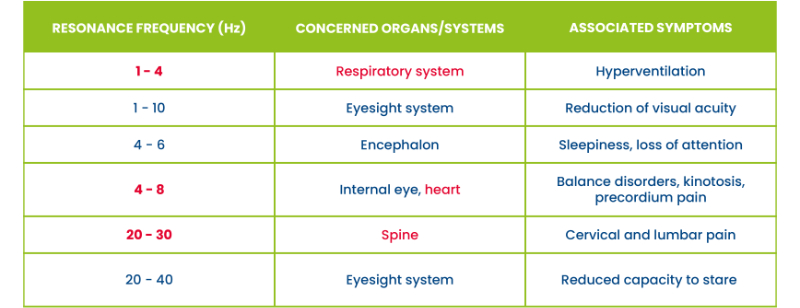
The human body is most affected by low frequencies between 2 and 20 Hz. The effects vary according to the organs involved: the table below shows the resonance frequencies of different organs and systems, and the associated symptoms.
What can we conclude?
The vibrations therefore affect the vital functions and cause physiological changes. Which can aggravate the clinical condition of the patient being transported.
The study highlights the need and the importance that the ambulance is equipped with devices capable of attenuating the vibrations transmitted to the patient. The main culprits of secondary damage for transport which we discussed in the first part of the article.
Transport pathologies: the approach to start from
An interesting concept to start with to tackle the issue from a different perspective than what has been done so far. It can be found in the guidelines of the HEMS Association (Helicopter Emergency Medical Service) of 2014 relating to the use of immobilization devices. The document states that immobilization techniques and the application of devices do not constitute the therapy. But they rather are focusing on a precautionary practice aimed at avoiding the so-called “Transport pathologies”. Furthermore, if this principle is accompanied by the idea that extra-hospital rescue is a process that starts at the time of the emergency call and ends with the patient being taken over by the medical staff of the hospital structure. Foundations for an essential awareness to minimize the effects of ambulance transport can be laid down.
The most important factors
What should be emphasized is that the driving style, as well as the type of vehicle carrying the patient are important factors. However, they are not decisive in risk management. In other words, even careful driving on a vehicle equipped with moderate comfort may not be sufficient to mitigate the effects of transport on the patient’s medical conditions. Not only that, transport pathologies do not only affect patients who have suffered trauma, but also all those affected by other pathologies.
Specific technological solutions against damage risks for transport
Over the years, there have been different solutions capable of addressing the problems we have discussed. They have been recognized by industry operators as valuable allies.
One of them is the shock-absorbing stretcher supports. Specifically designed to reduce the effects of vibrations and stresses to which the person being transported is subjected.
EDEN of Stem
The first company in the world to have created a shock-absorbing stretcher support was Stem Srl, a leading company in the sector of advanced devices for ambulance transport. EDEN is the only shock-absorbing stretcher support equipped with self-adjusting hydropneumatic suspension. As well as based on the patient’s weight, designed to absorb transverse stresses with respect to the direction of travel and therefore capable of significantly reducing the amount of vibrations which normally affect the transported patient.
As extensively discussed in the first part of the article, the adoption of specific equipment aimed at reducing secondary damage for transport is, to date, the most effective solution in the short and medium term. In order to raise the quality standards of rescue.
Conclusions
More than forty years after the creation of the Anglo-Saxon model for the management of extra-hospital emergencies. As well as twenty years after the establishment of the emergency service in Italy, we need to refresh and implement the guidelines on both the modes of transport and the devices that the emergency vehicles must be equipped with. In order to offer a high-performance and high-quality service. On the other hand, in recent years, we are already witnessing a questioning of some of the key principles of rescue. One for all the immobilization techniques, analyzed for the first time after years of their adoption to weigh their effectiveness. and its validity over time.
The goal
Waiting for the vehicles used for setting up rescue vehicles to be specifically designed for people transport, and therefore adequately equipped to minimize the risks to which patients and operators are subjected during transport, we believe that individual local organizations that provide intervention and assistance services bear the responsibility of choosing the best devices on the market.
1 Nataletti P. et al., «Studio pilota dell’esposizione a rumore e vibrazioni egli addetti dei mezzi di soccorso del 118 e dei trasportati». ISPESL, Dipartimento di Igiene del Lavoro, Laboratorio Agenti Fisici, Monte Porzio Catone (RM).