
Stem innovation in military rescue
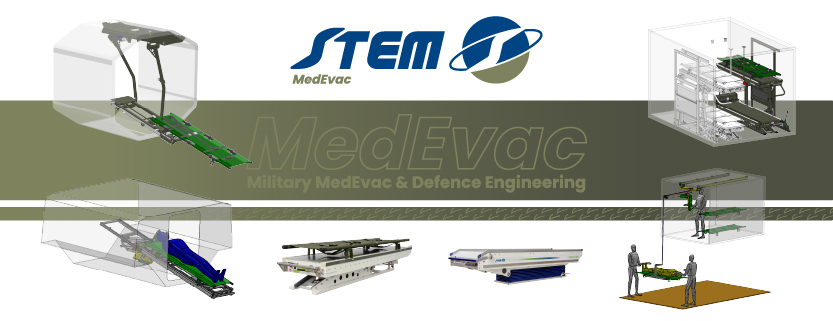
The world is evolving rapidly, and with it the demands of healthcare rescue operations. New operational scenarios require increasingly reliable, flexible solutions capable of performing under extreme conditions.
Stem, an Italian company and a leader in the design and manufacturing of patient transport systems, develops technologies capable of meeting these challenges, drawing on decades of experience in the emergency sector. Alongside solutions dedicated to civilian rescue, the company has also developed technologies for patient transport in military environments.
At the core of this development lies the work of the Research & Development department, which transforms complex operational needs into concrete engineering solutions.
The Role of Research & Development
The Research & Development (R&D) department was established with the aim of translating field requirements into design solutions capable of accurately meeting customer needs.
At the same time, the team conducts continuous research to track market evolution and anticipate emerging trends. This approach enables Stem to develop increasingly advanced systems, adaptable to a wide range of operational contexts.
It is precisely from this expertise that several solutions dedicated to military patient transport have been developed.
Complex Operational Scenarios
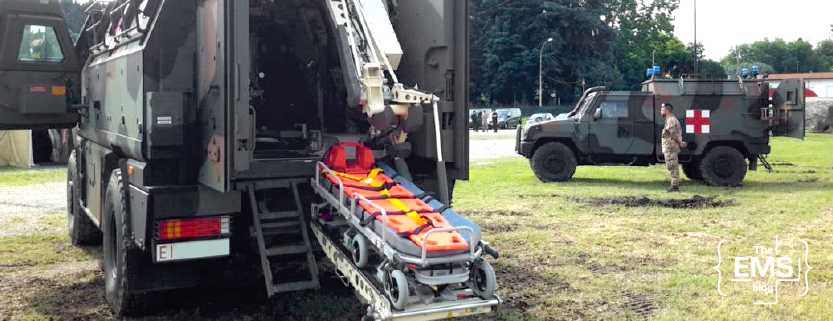
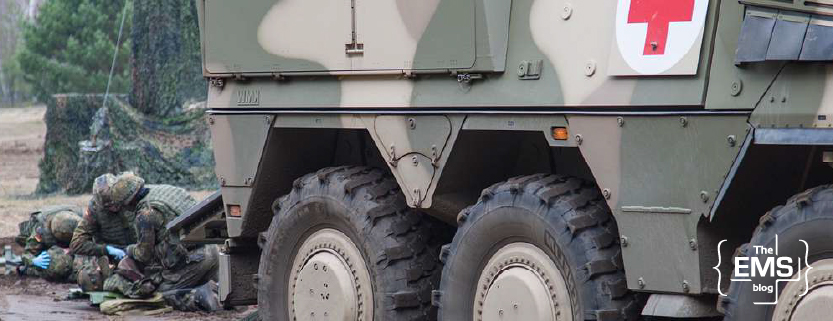
Medical Evacuation (MedEvac) operations differ significantly from civilian rescue. Patient transport often takes place on off-road or armored vehicles, designed to withstand extreme environmental conditions and equipped with ballistic protection.
These vehicles are characterized by limited internal space, very high loading heights and highly complex internal configurations. In many cases, multiple patients must be transported simultaneously, while ensuring crew safety and enabling medical treatment during transfer.
Designing for Operational Efficiency
To address these challenges, Stem has developed its systems according to three fundamental design principles: versatility, ergonomics and safety.
- Versatility, as military vehicles often need to adapt to different missions. Patient transport systems must therefore be compatible with various types of stretchers and configurable according to available space.
- Ergonomics, as loading operations and patient handling must be performed quickly and under demanding conditions. Reducing operator effort and facilitating handling procedures becomes a decisive factor.
- Safety, as military patient transport exposes both patients and operators to particularly intense stresses. Systems must ensure secure fastening, controlled movements and reliability even under extreme operating conditions.
Stem Systems for Military Patient Transport
The experience gained in the sector has led to the development of a range of solutions designed for military patient transport.
Revel-S: Multipurpose system for civilian and military stretchers
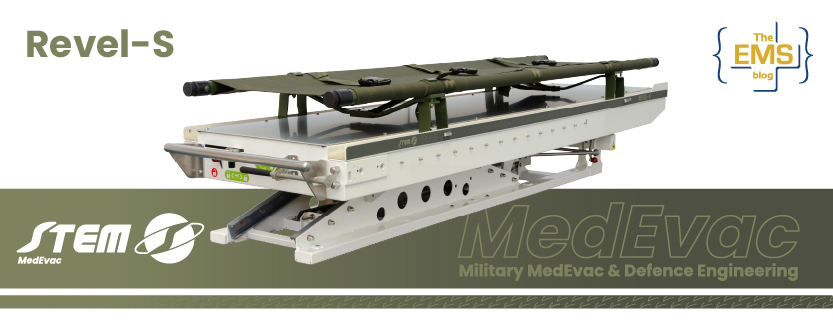
Revel-S is a fully mechanical multipurpose system for transporting both civilian and military stretchers. It is compatible with STANAG 2040 military stretchers as well as civilian self-loading stretchers such as Stem Spyke. This allows the same vehicle to be used for both operational missions and routine healthcare activities.
Hydraulically assisted movement and the extendable tray facilitate loading even on vehicles with high loading heights, ensuring controlled motion while reducing operator effort.
Revel-D: Configuration for transporting four stretchers
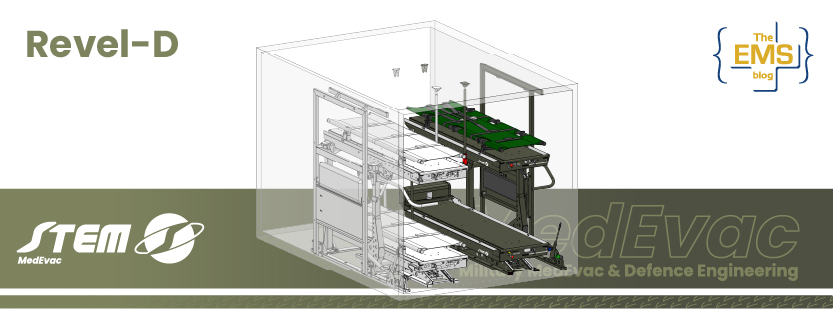
Revel-D introduces a dual-level configuration designed to optimize the medical compartment and increase the operational efficiency of vehicles used in MedEvac missions.
The structure is designed to transport up to four stretchers, adapting to the internal dimensions of the vehicle and specific operational conditions. Movements are fully manual and assisted by hydraulic dampers and gas springs, a design choice that prioritizes reliability and operational continuity.
Stamina: Suspended stretcher support for mine-protected vehicles
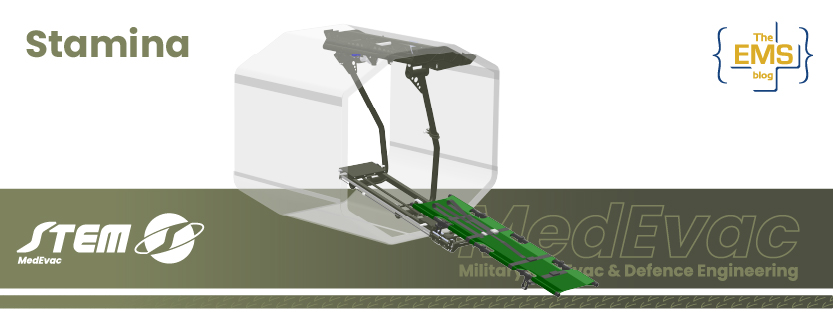
Stamina is a stretcher support designed for military vehicles equipped with mine protection. To meet this requirement, the stretcher support is fully suspended and fixed to the ceiling of the medical compartment using vibration-damping elements, remaining separated from the floor and walls of the vehicle. This solution reduces the transmission of shocks and stresses originating from the vehicle floor, caused by rough terrain or explosive events. At the same time, the suspended configuration optimizes space within the medical compartment and allows personnel to operate with greater freedom of movement.
Fold-Guard: Stretcher support with five degrees of freedom
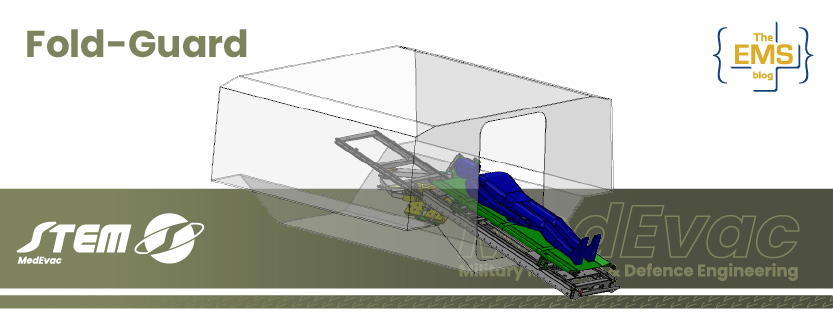
Fold-Guard is designed for armored vehicles requiring extensive movement capabilities of the stretcher platform within the medical compartment.
Thanks to its five degrees of freedom, the stretcher support allows the stretcher to be repositioned according to the vehicle configuration. When not in use, it can be folded parallel to the wall, freeing up space for crew seating.
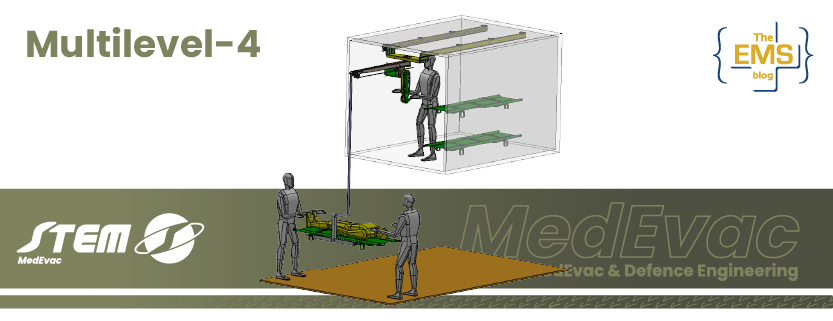
Multilevel 4: Transport of up to four stretchers on high-loading vehicles
Multilevel 4 is designed for vehicles with particularly high loading platforms, exceeding 1600 mm from ground level.
This configuration enables lifting and positioning of up to four STANAG 2040 stretchers, transferring the patient directly from ground level into the vehicle, minimizing operator effort.
Eden HV-2000: Shock-absorbing stretcher support for special vehicles
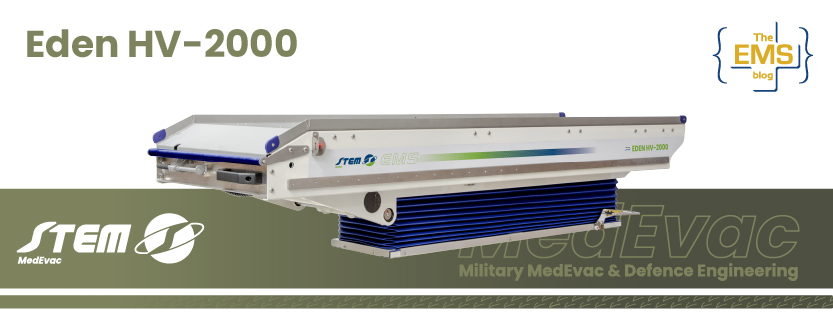
Eden HV-2000 is a shock-absorbing stretcher support developed for vehicles with high loading heights and for the transport of polytrauma patients.
Equipped with active hydropneumatic suspension, it automatically adapts to the patient’s weight, reducing vibrations during transport. The triple-extension tray facilitates loading onto special vehicles and allows more efficient space management within the medical compartment.
Innovation and Reliability for the Future of Rescue
In healthcare rescue, especially in military environments, every design detail can make a difference.
Stem’s extensive experience in patient transport, combined with the continuous work of its Research & Development department, enables the development of reliable systems even in the most complex operational scenarios.
Designing for extreme conditions means anticipating operational challenges before they arise in the field—and it is precisely this capability that continues to drive Stem innovation in the healthcare rescue sector.