
Manual handling regulations and assisted loading
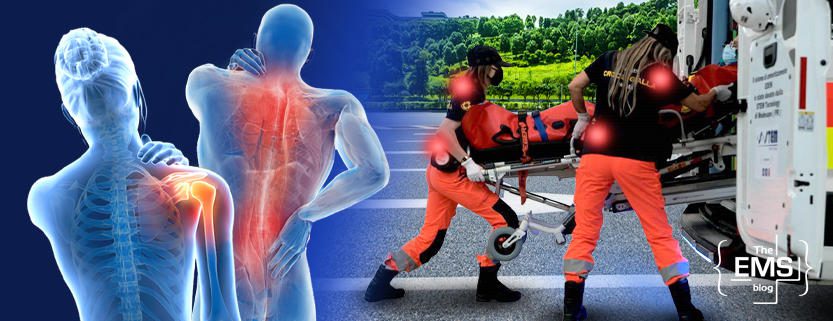
Manual loading is an important aspect of occupational health and safety prevention. That is why it is very importnt to follow manual handling regulations. Emergency operators and rescuers are among the categories of workers most exposed to the risk of excessive weight in patient handling. Assisted stretcher loading tech helps reduce effort and encourage proper posture.
Risk factors of manual loading – manual handling regulations
1 in 4 workers in Europe experience low back pain caused by poor working conditions or excessive physical effort. Percentage increases with age: over 50, it affects half of the people. EU has started a campaign called “Healthy and safe workplaces” for the next three years (2020-2022) based on these estimates. Lighten the load!” with the aim of promoting the prevention of musculoskeletal disorders (MSD) in the workplace.
1 out of every 3 workers develop neck problems from carrying or lifting heavy objects.
Manual Loading contemplates the operations of transporting a load by one or more workers. Also it includes the actions of lifting, depositing, pushing, pulling, carrying or moving a load.
Loading handling in medical rescue
Category of workers who handle heavy loads includes rescuers who have to move and transport patients, often in emergency conditions.
For this reason, during the training of operators, a session is always dedicated to patient and load handling techniques. The goal is to minimize the risk of incorrect maneuvers that can cause musculoskeletal damage to the spine.
Stretcher transport and patient loading
We pay great attention, in particular, to lifting and loading patients onto a stretcher and transporting them to the hospital. Stretcher is the fundamental tool for transporting patients and involves five phases of use.
First is unloading from the ambulance. Then approaching the patient, loading the patient, returning to the ambulance and loading the stretcher onto the ambulance. Operations that involve an active and demanding task for the rescuers.
Patient’s loading is the most critical moment – manual handling regulations
According to some biomechanical studies, the maximum tolerable load for the lumbosacral area is between 275 kg (women) and 400 kg (men). Disc breaking point (the disc-vertebra unit in the spine) is between 450 and 600 kg. Lifting a 70 kg patient can put a strain of up to 640 kg on the lower back. Also for this reason, there must always be at least two rescuers.
Importance of assisted loading to eliminate the effort
Technology can help operators to eliminate physical effort and the risk of lumbar pathologies. Of course, meanwhile maintaining following the manual handling regulations. Let’s see how.
For many years, all European organizations have been using self-loading stretchers for transport on emergency vehicles. That means stretchers equipped with folding legs with wheels for sliding.
Usually the loading and unloading from the ambulance is done manually and requires the commitment of two operators. To keep the operation safe, the operator needs to quickly bend their body and lift heavy objects using coded movements.
In these cases, assisted loading can replace manual effort. What is an assisted loading system? Powered system applies to the stretcher support, enabling the vehicle to load and unload the stretcher. All this without requiring any effort from the operators.
Assisted loading, the Sherpa system
Stem Technology has developed the Sherpa system. Operator block at the front attaches the stretcher using a restraint belt.
You can find the buttons for loading and unloading at the bottom of the stretcher support. They can also be on a bluetooth remote control for remote use. There is no physical effort required from the operators.
Sherpa is compatible with all stretchers, has a rechargeable battery, and a double safety system.
Also a very important thing is to keep the medical equipement in order. Find out more about it on our article Maintenance of Medical Equipment: How is it managed in Europe? on The Ems Blog!
 |
Do you know all about the Sherpa exclusive features? |