
Rescue Dog: requirements and training
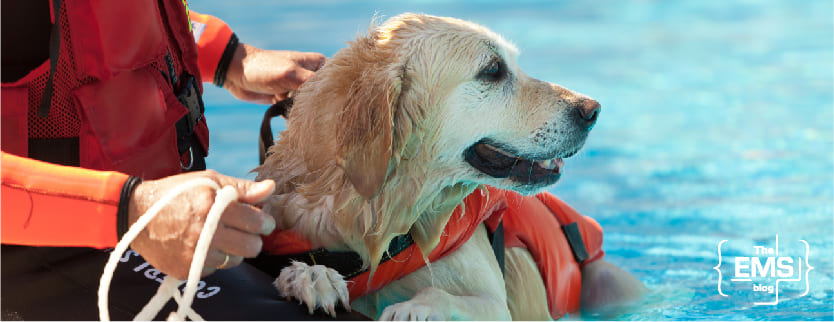
We are used to seeing them search for missing persons buried beneath rubble or buried under avalanches, or even rescue swimmers at risk of drowning. These are the so-called “rescue dogs.” This article will look who they are, what they do, and how they are trained.
It’s well-known that dogs are among humanity’s most loyal “friends”—intelligent, versatile animals capable of developing special empathy and an intense bond with humans. Recent scientific research even confirms that they can have some emotions similar to our own, such as joy, frustration, anger, and stress. Furthermore, their dedication to those who care for and love them is so profound that they do not hesitate to risk their own lives to protect them in times of need.
It is precisely due to these innate qualities that some dogs are employed in rescue operations in various contexts and natural environments. To become a “rescue dog,” the animal must have certain requirements, including belonging to specific breeds more suited for this type of work, and, most importantly, undergo specialized training with qualified personnel. In this article, we explore the activities in which rescue dogs are employed, the roles they perform, and the nature of their training.

Types of Rescue Dog
According to the Division of Criminal Justice Services in New York, there are many different ways to use dogs for search and rescue operations. Understanding these types can make the best use of search dog teams. The main types of work the dogs can do are generally categorized as a:
1. Airscent
These dogs work with their nose in the air, will ignore ground scent and will follow and locate people by catching the “hot” scent of people on the wind. Airscenting techniques are very effective for covering large areas quickly and can produce high probabilities of detection if conditions are good for airscenting. They don’t need a “last seen” starting point, an article to work from or a scent trail, and time is not an issue. Some airscenting dogs are also trained to scent discriminate, meaning they can be pre-scented on an article from the missing persons and can pick this person from others in the search area. Airscent dogs usually work off lead. Most are trained to find the victim, alert the handler when the victim has been found, and the return the handler to the victim. This is called a refind.
2. Cadaver / Human Remains Detection
They are used to locate the remains of deceased victims. Cadaver dogs can locate entire bodies (including those buried or submerged), decomposed bodies, body fragments (including blood, tissues, hair, and bones), or skeletal remains; the capability of the dog is dependent upon its training.
3. Avalanche Dogs
Victims that are caught in an avalanche, or even fall into a snow cave or tree well, are nearly impossible to find by the naked eye. Avalanche dogs are trained to detect human scent rising up from the snow and dig until they find the victim. Avalanche dogs cover more ground in less time than several human searchers can cover, which explains their importance.
4. Trailing/tracking
Trailing dogs are trained to follow a specific human scent, which may or may not approximate the path the person took because of factors affecting the dispersal of scent such as wind and temperature. To start the dog is started on the trail at the point where the victim was last seen (PLS). Trailing dogs will follow the route of scent deposited on the ground as a person moves through an area. A trained trailing dog can follow the steps of someone who passed by several days earlier, discriminate between it and another’s trail, and follow it over hills and through marshland. Dogs can even trail people in cars, from the scent that blows out of the window or through the vents of the car.
5. Disaster
Disaster work is a variation of airscent work. It combines the dog’s ability to find a person with special training required to work in disaster conditions, including collapsed buildings, mudslides, earthquakes, and floods. The disaster trained dog and handler spend a lot of time training control of the dog and directional control, so that the handler can send the dog onto rubble piles to perform closer searchers. Both dog and handler undergo extra training for searching on unstable and dangerous surfaces. The Federal Emergency Management Agency (FEMA) has a national program for disaster trained and certified dogs.
6. Water Dogs
Water dogs are trained to pick up scent in the water and alert their handler when they find that scent. Similar to picking up scent in snow, the scent rises up to the surface in the water. Cadaver dogs, also trained as water dogs, can be useful in drowning situations.

Characteristics of a Rescue Dog
Professionals assert that there is no single best breed for rescue work. However, not all dogs are suited for this type of activity and must meet specific characteristics:
– Resilience and ability to endure the demands of the job.
– Willingness to work in stressful situations, such as explosions and crowds.
– Strength to hold or drag people if necessary. Large breeds, such as the Newfoundland, are extremely useful in such situations.
– Motivation to handle long, time-consuming searches.
– Highly developed predatory instinct.
– Sociability.
– Ability to get along with people and other animals.
Breeds Suitable for Rescue Work and Their Traits
– Bloodhound: Everybody knows bloodhounds for their search and rescue talent. These dogs have more than 300 million scent sensors and can track a scent for miles. They are also very energetic, so they don’t get tired after long hours of work.
– Coonhound: Coonhounds also have a powerful sense of smell and can follow scent trails with a single-minded purpose. They were bred for hunting, so these dogs can keep their energy levels high for miles of running and searching. It’s important to note that they are also verry smart and loyal.
– Belgian Malinois: Belgian Malinois can boast of many talents making them outstanding rescue dogs. They are capable of spending long hours searching for items and rescuing people. Additionally, they are trainable. That’s why these dogs are often used in military and police departments. They are known for finding explosives, drugs and other types of evidence.
– Beagle: As the smallest of the hounds, Beagles are excellent tracking dogs because they can get very close to the ground. Beagles can stay focused on their goals, so they are a popular choice for police departments.
– Labrador Retriever: Known for their talents in swimming, running, and tracking, Labrador Retrievers excel at the most difficult search and rescue tasks such as bomb detection, water, and disaster recovery. This breed is also known for their intelligence, loyalty, and willingness to learn.

Mountain Rescue
In mountain rescue, dogs are often trained as ‘non-discriminatory air-scenting’ search dogs. As explained by Mountain Rescue Search Dogs England, they are not given a specific scent object but instead search for any human scent in the air.
The mountain rescue search dog associations in England and Wales (and those in Scotland, Ireland and the Isle of Man), have their roots in the Search and Rescue Dog Association (SARDA) which took shape in Scotland in 1965, inspired by the work of Hamish MacInnes, then team leader of Glencoe Mountain Rescue Team. Having witnessed the use of avalanche rescue dogs in Switzerland, he set up the first UK training course in Glencoe, in December 1964, and SARDA was formed the following year.
Initially, the organisation covered the whole of the UK but, by 1971, it had split across country lines into Scottish, English and Welsh associations. Currently, there are four mountain search dog associations specific to England and Wales: Mountain Rescue Search Dogs England, Lake District Mountain Rescue Search Dogs, SARDA South Wales and SARDA Wales.
Water Rescue
According to the Taste of the wild, water rescue dogs are trained to swim to the victim, who then grabs a handle on the top of the dog’s life jacket and is towed to safety. If the swimmer is unconscious, some dogs can flip the person on their back so their head is out of water, grip the upper arm and bring them to shore. Or if a small boat is stranded, the dog can use a rope to tow the vessel and passengers in.
Although any dog can go through training, the best water rescue dogs are large breeds that have the strength and endurance to tow people or even small boats over distances of a mile or more. (Pugs, Chihuahuas and bulldogs, for example, need not apply.) Breeds that naturally love the water (Newfoundlands, Portuguese water dogs and Labrador retrievers) are ideal. Of these breeds, the Newfie is probably the most popular water rescue dog. The breed’s large size gives it the power to haul survivors, and its thick, insulating coat enables it to withstand icy water temperatures. With webbed paws made for paddling and a tail that doubles as a rudder, this gentle giant is built to follow its natural instinct to watch over people.

A Perfect Symbiosis Between Dog and Handler
From around four months of age, puppies undergo various training phases including basic obedience, advanced obedience, swimming, overcoming any hesitation in water, and finally, complex rescue maneuvers. The entire process can take up to a year, though it may be shorter depending on the puppy and trainer. It should come as no surprise, then, that one of the most respected programs for water dog training is through the Newfoundland Club of America. The program consists of three tiers of training.
- Dogs that pass the first tier receive the title of “Water Dog.” These dogs have passed six tests, starting on land with basic obedience commands. In the water, the dog must successfully retrieve a bumper, fetch a lifejacket or boat cushion, deliver a rope to a “drowning” swimmer, tow a boat and swim with a handler, following commands.
- Dogs that successfully complete a more complex set of tasks receive the title of “Water Rescue Dog.” For example, the dog must determine which of three swimmers is “drowning,” bring that person a life preserver and help them back to shore.
- Finally, elite dogs can achieve the title of “Water Rescue Dog Excellent.” At this level, dogs must complete challenges that include taking a rope to multiple victims, rescuing an unconscious victim and finding a victim under a capsized boat and towing him or her to safety.
Conclusion
In essence, being a rescue dog is a full-fledged job, leveraging the animal’s natural inclinations which are enhanced and directed through specific training for the benefit of the community. Some call them “heroic” dogs, which might be a rhetorical stretch, but it’s a nice thought. In reality, rescue dogs are simply extraordinary animals.
To stay updated on rescue operations during maritime emergencies, follow our blog!